





Australian Energy Sector Cyber Security Framework
AESCSF Program of Assessment
The 2026 AESCSF Program is now open. The assessment portal is open from 10:00 AEDT 16th March until 20:00 AEST 1st May. Participants are encouraged to complete their submissions within this period to contribute to this year’s sector benchmarking progress.
We look forward to the participation of organisations across Australia’s energy sector in this year’s program and thank participants for their continued support in strengthening the cyber resilience of the energy system.
The AEMO Framework and Resources tab details the background, history, and evolution of the AESCSF Program with comprehensive guidance materials to support AESCSF users.
-
AESCSF background and history
Australia’s energy system is a complex, interconnected system that underpins our society. As the nation accelerates its transition toward cleaner energy sources and embraces digital transformation, the cyber resilience of its energy infrastructure has become a national priority.
Energy infrastructure is a high-value target for cybercriminals, state actors, and hacktivists. High-profile incidents - ranging from ransomware attacks on pipelines to coordinated attempts to disrupt power grids—have highlighted the vulnerabilities inherent in critical infrastructure. Australia, with its vast geography and interconnected energy market, is not immune.
Recognising these dangers, AEMO, in collaboration with the Australian government and with industry experts, sought to develop a harmonised approach to cyber maturity uplift tailored specifically for the Australian energy sector.
In 2018, the first iteration of the AESCSF framework was released. The framework was designed to provide a consistent, transparent, and practical approach for energy market participants to assess and enhance their cyber maturity posture. Drawing on global standards, such as the US National Institute of Standards and Technology (NIST) Cybersecurity Framework, the AESCSF was developed in close consultation with government agencies, cyber security experts, and industry stakeholders.
AESCSF is both a self-assessment tool and an industry-wide benchmark. It is designed to be adaptable and scalable, recognising the diversity of participants in Australia’s energy sector—from large transmission utilities to smaller renewable generators and retail operators.
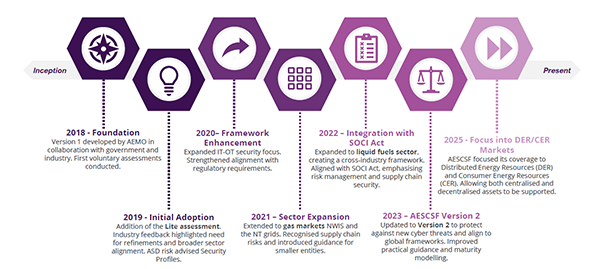
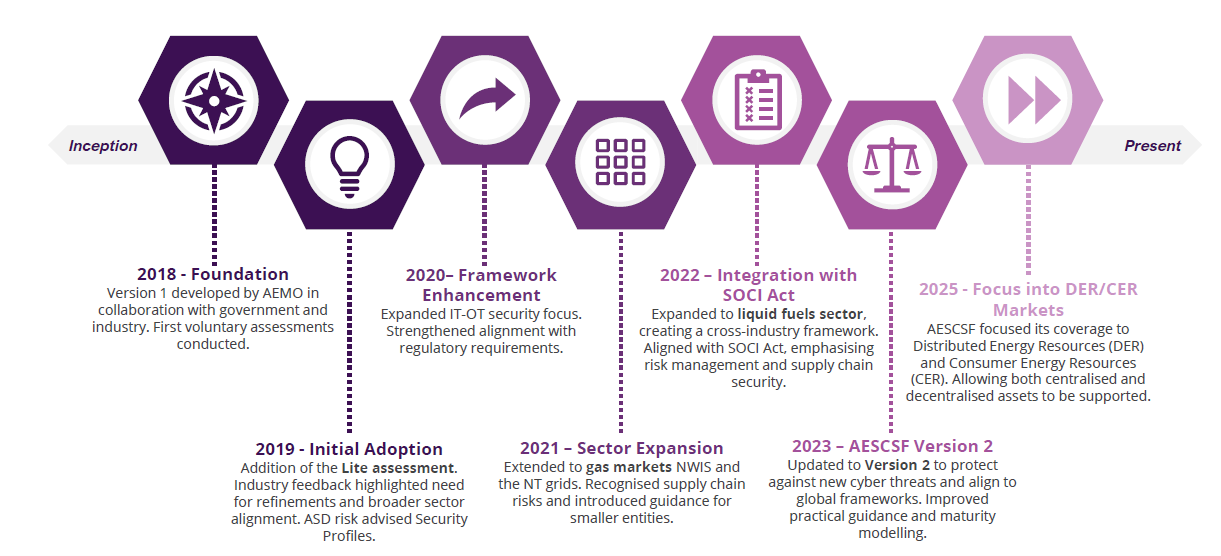
Click image to view full size -
Aims of the AESCSF
The aims of the AESCSF include:
- Standardisation: Establishing a common language and set of expectations for cyber security practices across the sector.
- Transparency: Providing participants with a clear, objective understanding of their cyber security strengths and weaknesses.
- Collaboration: Enabling the sharing of lessons learned, threat intelligence, and best practices between industry peers and with government agencies.
- Regulatory Alignment: Ensuring that cyber security practices align with national and international regulatory requirements, reducing the burden of compliance for participants.
- Continuous Improvement: Emphasising the importance of regular assessment, feedback, and adaptation in the face of rapidly changing threats.
Which in turn supports:
- Protecting Critical Infrastructure: By identifying vulnerabilities and driving remediation, the framework helps shield core assets from malicious threats.
- Maintaining Consumer Confidence: As cyber incidents become more common, demonstrating a proactive approach to cyber security reassures consumers and stakeholders.
- Supporting National Security: By bolstering the resilience of the sector, AESCSF contributes to the broader objective of safeguarding Australia’s national interests.
- Enabling Innovation: A secure environment encourages the adoption of new technologies—such as smart grids and distributed energy resources—by managing associated risks.
-
Challenges
While the AESCSF has made significant inroads, challenges remain. The energy sector’s size, diversity and rapidly changing threat landscape demand ongoing vigilance and adaptation. Small and medium participants may face resource constraints, requiring tailored support and guidance. Furthermore, increased digitalisation—through cloud computing, remote access and IoT devices—means that the attack surface continues to expand.
AEMO, alongside government partners such as the Australian Cyber Security Centre (ACSC) and the Department of Home Affairs, remains committed to supporting all market participants in navigating these complexities.
The AESCSF is not a static document; it undergoes regular updates to incorporate new threats, technologies and lessons from real-world incidents.
In an era when the stakes have never been higher, the AESCSF is more than a framework—it is a living embodiment of the energy sector’s shared commitment to security, reliability and national prosperity. As the threat landscape continues to evolve, so too will the AESCSF, ensuring that Australia’s energy sector stands ready to meet the challenges of tomorrow.
Contact
For further information on the AESCSF or to register for the Program, please contact the Project Team at [email protected].