





ISP Consumer Panel in their own words: March 2026
The 2026 ISP Consumer Panel members (Mark Henley – Chair, Jarra Hicks, Beverley Hughson and Craig Memery) share an update on their recent contributions to the two-year development of the 2026 ISP.
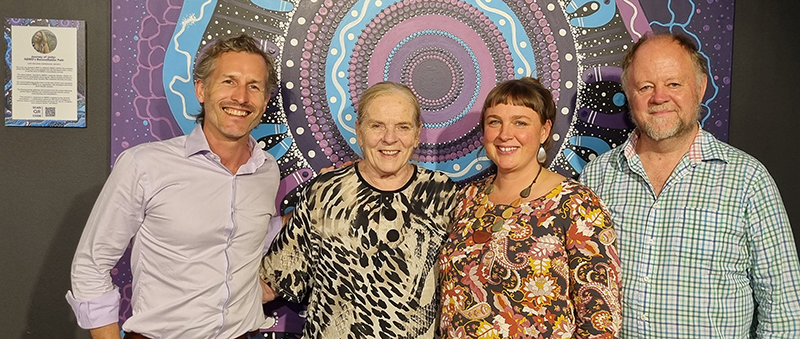
2026 ISP Consumer Panel members Craig Memery, Beverley Hughson, Jarra Hicks and Mark Henley.
Draft ISP
During the past three months, the Panel’s main work has focused on preparing a report in response to the Draft 2026 ISP that was released on 10 December 2026. The publication had 10 attachments, including the first Demand Side Factors statement as attachment 9.
Consequently, the Draft 2026 ISP, the fifth Draft ISP, is the most comprehensive to date and reflects an ever more impressive database, and consideration of deep questions about future energy markets and responses from a diversity of stakeholders. The Panel observed that the 2026 ISP is likely to be the ISP that shifted the focus from a (mainly) transmission plan to a transition plan, taking a more ‘whole-of-system’ perspective.
The ‘headline’ future path as reflected in the draft 2026 ISP continues as “… renewable energy, connected by transmission and distribution, firmed with storage and backed up by gas, presents the least-cost way …”
So, the Panel’s response has focused on ‘firming’ and ‘storage’ with much more attention on gas and batteries than on transmission. The Panel’s report commences by summarising several themes germane to the 2026 ISP, including:
- The ISP is a plan for transition to ‘net zero’ and this perspective is about consistent and methodical action over the period from now until 2050, at least.
- The Demand Side Factors (DSF) statement is new and reflects a shift to also focus on ‘demand side.’ The initial focus is on distribution networks, with the Panel also asking if the term ‘demand side factors’ is understood by consumers and, if not, should it be renamed?
- Gas: its cost, availability and ‘relationship’ with batteries remains vexed (as in ‘difficult to resolve or understand’). For gas, the less it is used for electricity generation as more renewables are dispatched, the more expensive it becomes and the less likely there will be investor interest, without a massive premium.
- Communication is crucial: Consumers are desperately seeking honest, clear information from multiple trusted sources. Given AEMO is now one of, hopefully, a growing number of consistent voices on energy matters, AEMO needs to plan for how to communicate effectively and widely.
- Coordination. On page 20 of the executive summary, AEMO wrote “To deliver the ODP, continued coordinated action is needed from industry, governments and market bodies, including in their engagement with communities”. In its submission on the Draft 2026 ISP, the Panel has emphasised the importance of this short sentence in achieving best outcomes for consumers.
The Draft 2026 ISP projects lower levels of coordinated CER than the 2024 ISP. Noting the growing CER investment, the Panel has questioned this observation.
The tension is highlighted between “just get on with it – the planet cannot afford more delays” and “proactive engagement”, particularly with consumers, to build social licence and identify solutions that work for local communities as well as ‘whole of system’. They are not necessarily antithetical, but in many debates as presented as such.
Demand Side Factors statement
A late 2024 rule change led to a Demand Side Factors (DSF) statement being a requirement of the ISP. The Panel is really impressed by the dedicated effort that AEMO staff have put into producing the first DSF, with much on the ‘to do list’ for the 2028 DSF.
The Panel’s response to the DSF has focused on CER, the potential for community energy and the need to put greater focus on energy efficiency.
We were also greatly assisted by participants in a DSF workshop that we were able to co-host with AEMO, in Sydney. Comments from this workshop are included in out report, as an appendix.
To gain a rough sense of the level of total consumer investment through CER, the Panel estimated 2025 spending on PV and home batteries and extrapolated similar spending levels out to 2050 and came up with $175 billion (2025) as a rough estimate; this is compared to AEMO’s estimate of the cost of the optimal development path from the draft 2026 ISP being $128 billion (2025), highlighting the magnitude of direct consumer investment in electricity.
The take up of subsided home batteries has also been of particular interest. On 23 December 2025, AEMO released its latest Forecasting Assumptions Update (a part of the ESOO process) with some background papers, including a PV and batteries update.
This is really interesting data and shows how quickly some variables change. The Panel suggested that AEMO seek to incorporate this recent data into the calculations for the final 2026 ISP.
AEMC Review of the ISP
The Panel met with the AEMC team responsible for conducting the ISP review, with focus on the Consultation Paper released in December 2025.
The AEMC proposed a framework of six themes to contribute to a ‘fit for purpose ISP’:
- Purpose and role
- Development and process
- Actionability
- Stakeholder engagement and transparency
- Transmission planning
- Adaptability.
The Panel has responded to the themes saying:
- The place of and a focus on outcomes for consumers is not clear in this framework.
- The NEO commences “to promote efficient investment in, and efficient operation and use of, electricity services for the long-term interests of consumers of electricity” … the ISP has this overarching objective. The descriptor from the initial review papers of a Fit for Purpose ISP should be replaced by ‘ISP Enabling Best Outcomes for Consumers’ or similar.
- The ‘transmission planning’ theme is too narrow for future ISP focus which will likely be more of a ‘whole-of-system plan’ than a ‘transmission plan’, with increasing focus on firming and storage. The Panel opines that actionable project status should be extended to large-scale storage and firming projects as well as transmission projects. The ‘transmission planning’ theme should be replaced by ‘planning for the transition,’ ‘energy system planning’ or similar.
- There does not appear to be a clear focus on consumer energy resources (CER) in the themes, yet the Panel thinks consumers will invest more in energy from now to 2050 than the projected ODP investment. The Panel has suggested adding ‘distributed energy, including CER/DER’ as a theme.
2028 ISP
Scenarios
Scenarios are the starting point for the ISP two-year cycle. The Panel recognises that, for consistency and some international comparison, there is merit in retaining something like the three current scenarios, but the Panel also suggests that a fourth scenario be added for 2028 with a focus on a distributed energy scenario. This will no doubt be hotly debated; the Panel thinks it is a great debate.
2028 Consumer Panel
Expressions of interest to be a part of the 2028 ISP Consumer Panel are welcomed from 25 March 2026. Please consider applying and spread the word too, it is an important role. If anyone wants to talk with a member of the current Panel about what is involved, please email [email protected].