





ISP Consumer Panel in their own words: September 2025
The 2026 ISP Consumer Panel members (Mark Henley – Chair, Jarra Hicks, Beverley Hughson and Craig Memery) share an update on their recent contributions to the two-year development of the 2026 ISP.
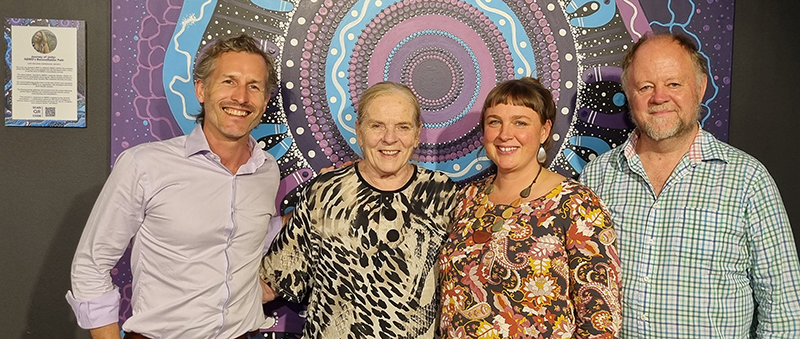
2026 ISP Consumer Panel members Craig Memery, Beverley Hughson, Jarra Hicks and Mark Henley.
In many ways, the first of two main stages of the ISP process has been completed with the release of the final 2025 Inputs, Assumptions and Scenarios Report (IASR) at the end of July. This completes a monumental amount of work by AEMO staff and the consumers and stakeholders who have provided input to the many consultations that have led to this finalisation.
We reflect that there were more inputs to the process for the 2025 IASR than for any previous IASR report. Relevant reports being:
- Issues paper and Draft Methodology
- Draft 2025 IASR Stage 1
- Draft 2025 IASR Stage 2, including multi-sectoral modelling
- Draft GenCost report
- Draft 2025 Electricity Network Options Report
- Draft 2025 Gas Infrastructure Options Report.
These reports, in combination and without supporting documents, provided over 800 pages of carefully crafted and detailed information. The ISP Consumer Panel has responded to each of these reports but is well aware of the reality that, as the ISP becomes ever more detailed and we suggest is looked to for ever more answers, the amount of information and complexity makes consumer engagement with any other than the most dedicated consumer advocates very difficult. So, gaining consumer perspective is an ongoing challenge, and one that will almost certainly be greater for the 2028 ISP.
Scenarios
In the final 2025 IASR report, AEMO allocated new names to two of the scenarios, so that:
- Progressive Change is now Slower Growth
- Step Change continues to be named Step Change, and
- Green Energy (exports) scenario has been renamed as Accelerated Transition.
The Panel appreciated a series of discussions with AEMO staff about the scenarios and supports the new set of scenario descriptors. The 2025 IASR was also the first time that the ISP Consumer Panel was able to engage on scenarios from the beginning of the process. We think that each descriptor is clear for the relevant scenario and all three scenarios are now ‘domestic market’ focused (rather than the previous Green Energy scenario which had an exports focus). We think this provides greater consistency across the three scenarios.
Behind the scenarios is a set of parameters. Each scenario has the same parameters but there are different settings for each scenario. One of the discussions that this prompted between the Panel and AEMO staff was about whether a Slower Growth scenario means that the CER parameter will also be lower than that parameters value in the other two scenarios. We suggested that slower economic growth may well result in a higher level of CER investment as households and businesses, who can, invest in CER to reduce their energy costs.
Policy settings
The final IASR usefully summarises (page 30) the various policies that have been included in the 2025 IASR, recognising that this is a strongly debated topic. For example, some people argue that some jurisdictional policies should not be included in the ISP while there are other policy initiatives that others think should be included because they may be imminent, or just desired. AEMO has been highly transparent in how it deals with these perennial debates. A table on pages 46-47 summarises policy changes since the draft IASR (5 policies) and since the 2023 IASR (15 polices), reflecting how rapid the change is in energy market policy.
Australia’s 2035 carbon emissions target is likely to be released soon, but the IASR sticks with the policy that is current at the time of the report’s release.
The Panel is generally satisfied that the data detail presented in the final IASR provides a solid basis for the next stage of 2026 ISP modelling and Candidate Development Path development. Now the fun begins, as the year of data development and collection is converted into a draft ISP by December this year.
What’s next?
As of early September 2025, the Panel is producing our response to the Final IASR, a requirement for the Panel specified in the National Electricity Rules (clause 5.22.7) and we are also talking with AEMO about a number of matters, foremost being:
1. Sensitivities
Sensitivities are useful in modelling to check variations in key parameters and are highly sought after. The complexity of modelling means that AEMO is limited in how many sensitivity checks can be conducted. The Panel has discussed this matter with AEMO and suggested our priorities for sensitivity analysis, starting with:
- Discount rates: noting different costs and benefits for different technologies / polices, etcetera
- Batteries: what if there are more of them – and at lower cost? (Both for home and utility scale batteries.)
- Different degrees of orchestration
- Social licence considerations: for example, substantial delays / cost increases.
2. Scenario weighting
Previous ISP processes have utilised a Delphi Panel approach to determine weightings for perceived likelihood of the three scenarios. This is then used as part of Optimal Development Path calculations. Discussions are underway about whether the Delphi Panel approach can be improved for the 2026 ISP.
3. Social licence
This is an ongoing topic of discussion and exploration.
Contact the 2026 ISP Consumer Panel
The Panel is continually exploring approaches that will enhance input to any aspect of the ISP by consumer interests and can be contacted with any suggestions via [email protected]